Data handling and visualization using Python
CMOS, June 2014
The presentation is available here: http://tinyurl.com/cmos2014



Introduction and history
What is Python??
"Python is a widely used general-purpose, high-level programming language. Its design philosophy emphasizes code readability." wiki)
"Python is powerful... and fast; plays well with others; runs everywhere; is friendly & easy to learn; is Open." python.org
What is Python??
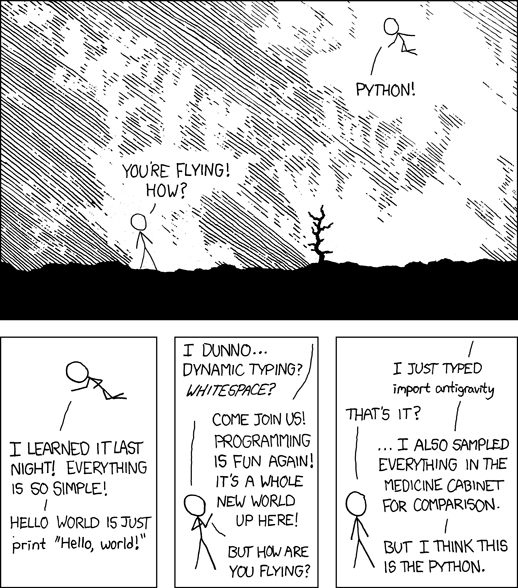
What is Python??
Readable and interpreted
- Not compiled (computer executes in order)
- Easy to develop, debug, and share
Easy to learn, powerful, and fast
- High-level and dynamically typed
- Interfaces with compiled languages (e.g., C, C++, Fortran)
- Versitile libraries "under the hood"
Open and free
- Community support and development
- Skills transfer without overhead (no site lisence)
Example uses for Python
- General programming (e.g., clock applet in Ubuntu)
- Video games (e.g., Ubisoft in Montreal)
- Web development (e.g., Pinterest, Instagram)
- Data analysis (e.g., visulalization, multi dimensional data, statisitics)
- Scripting (e.g,. automating system tasks, smart file manipulation)
Talk on Python history by Python developer Guido Van Rossum here.
Some things I've done with python: lake level observations
More cool examples:
Outline part I
Python basics
IPython and basic python syntax
Builtin data types
Operations on file system, strings and dates
Libraries for scientific computing
- NumPy/SciPy
Handling NetCDF4 files
- Netcdf4-python
Getting started
Open a new terminal: Ctrl-Alt-T (Ubuntu) or search for 'terminal' in the dash
Make a working directory
$ mkdir python_workshop
Change into new directory
$ cd python_workshop
First create new python script (for later)
$ gedit example01.py &
List the files in directory
$ ls
Launch the ipython terminal
$ ipython
Using python as a calculator
# Try addition, subtraction, multiplcation, and divison
2 + 2
3 - 1
2 * 2
3 / 2;
# Careful with division!
# older python versions treat 2 as an integer and 2. as a float
3 / 2.;
# Try exponentials
2 ^ 3
# this is actually an XOR NOT exponential!
2 ** 3
9 ** .5
Using python as a calculator (scientific)
import math

# Create a variable for pi
pi = math.pi
print pi

math.cos(pi)

math.exp(1)
Use the 'Tab' auto-complete in iPython to list other math functions.
Note: math only works on scalars, not arrays (with arrays we will use numpy)
Quick overview: native types
Basic data types
string (str): 'This is a string', "'This' too"
int: 0, 1, 20, 1000
float: 0.0, 1.0, 20., 1000.0000001
bool: True, False
Data containers
list: [1,2,4, 5, "I am a fifth element"]
tuple: (1, 2, 3)
dictionary (dict): {'key':'value', 'key2':['list','of','values'], ...}
Extended types (requires an import)
datetime: datetime.datetime.now(), datetime.datetime.utcnow()
array: numpy.array([1,2,3,4])
Quick overview: Flow control
Python uses a four-space indent for loops, case statments, and function definition
Loops:
    for item in item_list:
        # Do something, for example:
        print item

     while condition==True:
         # Do something
Quick overview: Flow control
Case statements:
    if condition == True:
        # Do one thing, for example:
        print condition

    elif condition == False:
        # Do something else
        print 'This condition failed to pass'

    else:
        # If neither condition is satisfied
        print 'Warning, condition was not satisfied!'
Quick overview: Flow control
Function definition:
def my_func(input_a, input_b):
    """This is my function documentation"""

    output = input_a + input_b

    return output
Quick overview: Syntax
#Variable decalaration <-This is a comment
a = 10; b = "climate"; x = None;

x = [1,2,4, 5, "I am a fifth element"]

#looping
for item in x:

    #Checking conditions
    if type(item) == int:

        print(item ** 2 % 10),

    else:

        msg = ", but my index is {0}."
        msg = msg.format(x.index(item))

        print item + msg,

#now we are outside of the loop since no identation
print "\nSomething ..."
Builtin data types
Strings
s = "climate"
#reverse (also works for lists)
print s[-1::-1]
#Dynamically changing parts of a string (for left right justification use '>', '<')
tpl = "Formatting floats: {0:.3f};\nformatting integers: {1:05d};\nformatting dates: {2: %Y-%m-%d %H:%M}"
print tpl.format(789.3342353554, 32, datetime.now())
Strings
#Splitting
s = "This,is,a,sentence"
s_list = s.split(",")
print s_list
Strings
#joining a list of strings
list_of_fruits = ["apple", "banana", "cherry"]
x =   """
        I would like to eat
        {0}.
        And by the way I am a multiline string.
      """
print x.format(" or ".join(list_of_fruits))
Strings: regular expressions
#regular expressions module
import re
msg = "Find 192, numbers 278: and -7 and do smth w 89"
groups = re.findall(r"-?\d+", msg)
print groups
print [float(el) for el in groups] #convert strings to floats
Dates
#What time is it
from datetime import datetime
d = datetime.now(); print d
#hours and minutes
d.strftime("%H:%M"), d.strftime("%Hh%Mmin")
Dates: How long is the CMOS 2014?
start_date = datetime(2014, 6, 1, 8, 30)
end_date = datetime(2014, 6, 5, 17)
print end_date - start_date
#you can mutiply the interval by an integer
print (end_date - start_date) * 2
You can generate dates for timeseries with arbitrary steps
from datetime import timedelta
dt = timedelta(days = 5, hours = 6, minutes = 25)
d0 = datetime(2005, 4, 23)
[str(d0 + i * dt) for i in range(10)]
You can use the calendar module for different convenience functions with dates
Example: how many days in a given month in 3001?
import calendar
for month in range(1, 13):
    weekday_of_last_day, ndays = calendar.monthrange(3001, month)
    print ndays,
Follow an example
Data from the IML-4 buoy outside Rimouski provided by the St. Laurence Global Observatory

Download data here save it in the working directory python_workshop we created earlier.

Follow an example
Extract the and open the data to prepare for parsing.
$ tar -xzf IML-4_example.tar.gz

$ gedit IML-4_salinite.txt
    IML-4 — Water salinity —
    Date     Time (UTC)     Water salinity (PSU)
    2013-05-28     10:18:22 PM     24.7712
    2013-05-28     10:33:22 PM     24.7736
    2013-05-28     10:48:22 PM     24.7924
    ...
    2013-10-30     04:33:22 PM     25.7566
    2013-10-30     04:48:22 PM     25.7388
Follow along with the example, the completed examples are available for reference in the complete_examlpes directory.
Exercises: Operations with strings, dates and file system
- Check what this statement prints
print 5 * "123"
Count the number of files and number of folders in your home or in the current directory.
Get the sum of digits (not numbers) in the sentence below using module
re.This is a 78 sentence very confusing (1) which might change232 so you need to 346 automate the procedure of extracting the /21e893/ useful information from here10.21?
Figure out on which day of week you were born (see the
calendarmodule), you can have fun by determining on which day of week you'll have your next birthday.Assume you have a timeseries of length 10000. You know that it starts on 2009-01-02 at 18:00 and the time step is 17 hours 25 minutes, what is the date and time corresponding to the last point of the timeseries.
List comprehensions and sequences
#square eleaments of a list
#list comprehension
print [the_el ** 2 for the_el in the_list]
#Generating list or iterable of integers
print range(1,20)
Builtin data containers (lists)
the_list = [3,6,78,9,0,32,13]
##There are some utility functions that can be applied to lists
the_list.sort(reverse = True)
print the_list
#loop through several lists at the same time
for el1, el2 in zip(the_list, other_list):
    print(el1+el2),
Builtin data containers (dictionary)
#dictionary
author_to_books = {
"Stephen King":
    ["Carrie","On writing","Green Mile"],

"Richard Feynman":
    ["Lectures on computation",
     "The pleasure of finding things out"]
}
#add elements to a dictionary
author_to_books["Andrey Kolmogorov"] = \
        ["Foundations Of The Theory Of Prob..."]
Builtin data containers (dictionary)
#print the list of authors
print author_to_books.keys()
#Iterate over keys and values
for author, book_list in author_to_books.iteritems():
    print author, " wrote ", book_list
Exercises: builtin containers
Find a sum of squares of all odd integers that are smaller than 100 in one line of code (Hint: use list comprehensions)
Check what this statement prints
print 10 * [18,]
NumPy
The library for fast manipulations with big arrays that fit into memory.
import numpy as np
#Creating a numpy array from list
np_arr = np.asarray([253,1.9,23, 4, 3.5,6,7,86, 18.9, 10, 89, 99])
print np_arr
print np_arr + 1
print np_arr ** 2
print np_arr + 5 * np_arr
NumPy
#Reshape
np_arr.shape = (3,4)
print np_arr
#sum along a specified dimension, here
print np_arr.sum(axis = 1)
Numpy
#create prefilled arrays
the_zeros = np.zeros((3,9))
the_ones = np.ones((3,9))

print the_zeros
print 20 * "-"
print the_ones
Numpy provides many vectorized functions to efficiently operate on arrays
print np.sin(np_arr)
print np.where(np_arr == np_arr.min()) # <--- indices of the minimum value
You can mask arrays easily (and the plotting library will recognize your masking)
masked_np_arr = np.ma.masked_where(np_arr > np.percentile(np_arr, 75), np_arr)
print masked_np_arr
Numpy: fancy indexing
arr = np.random.randn(3,5)
print "Sum of positive numbers: ", arr[arr > 0].sum()

print "Sum over (-0.1 <= arr <= 0.1): ", \
       arr[(arr >= -0.1) & (arr <= 0.1)].sum()

print "Sum over (-0.1 > arr) or (arr > 0.1): ", \
       arr[(arr < -0.1) | (arr > 0.1)].sum()
Exercises: Numpy
- Generate a 10 x 3 array of random numbers. Count the number of positive and negative elements.
- Checkout numpy for MATLAB users transition table.
SciPy packages
scipy.constants- Physical and mathematical constantsscipy.fftpack- Fourier transformscipy.integrate- Integration routinesscipy.interpolate- Interpolationscipy.io- Data input and outputscipy.linalg- Linear algebra routinesscipy.ndimage- n-dimensional image packagescipy.optimize- Optimizationscipy.signal- Signal processingscipy.sparse- Sparse matricesscipy.spatial- Spatial data structures and algorithmsscipy.special- Any special mathematical functionsscipy.stats- Statistics
And more ...
SciPy: ttest example
from scipy import stats
#generating random variable samples for different distributions
x1 = stats.norm.rvs(loc = 50, scale = 20, size=100)
x2 = stats.norm.rvs(loc=5, scale = 20, size=100)
print stats.ttest_ind(x1, x2)
x1 = stats.norm.rvs(loc = 50, scale = 20, size=100)
x2 = stats.norm.rvs(loc=45, scale = 20, size=100)
print stats.ttest_ind(x1, x2)
SciPy: integrate a function
$$ \int\limits_{-\infty}^{+\infty} e^{-x^2}dx \;=\; ? $$
from scipy import integrate
def the_func(x):
    return np.exp(-x ** 2)
print integrate.quad(the_func, -np.Inf, np.inf)
print "Exact Value sqrt(pi) = {0} ...".format(np.pi ** 0.5)
Modules and classes to operate on
File system (
os, shutil, sys)- create folder, list folder contents, check if file or folder exists
Strings (+, *, join, split, regular expressions)
Dates (datetime, timedelta, )
File system
import os
#print current directory
print os.getcwd()
File system
#get list of files in the current directory
flist = os.listdir(".")
print flist[:7]
File system
#Check if file exists
fname = flist[0]
print fname,":", os.path.isfile(fname), \
      os.path.isdir(fname),  \
      os.path.islink(fname)
You might also find useful the following modules: sys, shutil, path
Netcdf4-python
The python module that for reading and writing NetCDF files in python, created by Jeff Whitaker.
Requires installation of C libraries:
NetCDF4
HDF5
Netcd4-python
Below is the example of creating a netcdf file using the netcdf4-python library.
from netCDF4 import Dataset
file_name = "test.nc"
if os.path.isfile(file_name):
    os.remove(file_name)

#open the file for writing, you can Also specify format="NETCDF4_CLASSIC" or "NETCDF3_CLASSIC"
#The format is NETCDF4 by default
ds = Dataset(file_name, mode="w")
Netcdf4-python: create dimensions
ds.createDimension("x", 20)
ds.createDimension("y", 20)
ds.createDimension("time", None)
Netcdf4-python: create variables
var1 = ds.createVariable("field1", "f4", ("time", "x", "y"))
var2 = ds.createVariable("field2", "f4", ("time", "x", "y"))

#add netcdf attributes
var1.units = "m/s"
var1.long_name = "zonal wind speed"
Write data to the file
#generate random data and tell the program where it should go
data = np.random.randn(10, 20, 20)
var1[:] = data
var2[:] = 10 * data + 10
#actually write data to the disk
ds.close();
%%bash
#check the file header:
ncdump -h test.nc
Netcdf4-python: reading a netcdf file
Open the netcdf file for reading:
from netCDF4 import Dataset
ds = Dataset("test.nc")
Select variables of interest: no data loading happens at this point
#what variables are in the file
print ds.variables.keys()

#now data is a netcdf4 Variable object, which contain only links to the data
data1_var = ds.variables["field1"]
data2_var = ds.variables["field2"]
#You can query dimensions and shapes of the variables
print data1_var.dimensions, data1_var.shape
Read data from the netcdf file for corresponding variables and time steps
#now we ask to really read the data into the memory
all_data = data1_var[:]
#print all_data.shape
data1 = data1_var[1,:,:]
data2 = data2_var[2,:,:]
print data1.shape, all_data.shape, all_data.mean(axis = 0).mean(axis = 0).mean(axis = 0)
Outline part II
Plotting libraries
Matplotlib
Basemap
Grouping and subsetting temporal data with
pandasInterpolation using
cKDTree(KDTree) classSpeeding up your code
Matplotlib
The module for creating publication quality plots (mainly 2D), created by John Hunter.
Matplotlib gallery
An alternative is PyNGL - a wrapper around NCL developed at NCAR.
Let us draw the data we just saved to the netcdf file.
Do necessary imports and create configuration objects.
import matplotlib.pyplot as plt
from matplotlib.colors import BoundaryNorm
from matplotlib import cm

levels = [-30,-10, -3,-1,0,1,3,10,30,40]
bn = BoundaryNorm(levels, len(levels) - 1)
cmap = cm.get_cmap("jet", len(levels) - 1);
Matplotlib: Preparations and options
#
font_size = 20
params = {
        'xtick.labelsize': font_size,
        'ytick.labelsize': font_size,
        'figure.figsize' : (9, 3)
}
plt.rcParams.update(params) #set back font size to the default value

def apply_some_formatting(axes, im):
    axes[1].set_yticks([])
    #format colorbar axes
    cax = axes[2]
    cax.set_aspect(20)
    cax.set_anchor("W")
    cb = plt.colorbar(im2, cax = cax);
Matplotlib: plotting 2 fields with nonlinear and shared colorbar
fig, axes = plt.subplots(nrows=1, ncols=3)
im1 = axes[0].contourf(data1.transpose(),
                       levels = levels,
                       norm = bn, cmap = cmap)
im2 = axes[1].contourf(data2.transpose(),
                       levels = levels,
                       norm = bn, cmap = cmap)
apply_some_formatting(axes, im2)

Execises: Matplotlib
Pandas
Initially designed to process and analyse long timeseries
Author: Wes McKinney
Home page: pandas.pydata.org
Download and analyse teleconnection indexes
For pandas 1D examples we will load, plot and correlate different teleconnection indices (source).
#Set name to link mapping
name_to_link = {
"AAO" : "ftp://ftp.cpc.ncep.noaa.gov/cwlinks/norm.daily.aao.index.b790101.current.ascii",
"AO" : "ftp://ftp.cpc.ncep.noaa.gov/cwlinks/norm.daily.ao.index.b500101.current.ascii",
"NAO" : "ftp://ftp.cpc.ncep.noaa.gov/cwlinks/norm.daily.nao.index.b500101.current.ascii",
"PNA" : "ftp://ftp.cpc.ncep.noaa.gov/cwlinks/norm.daily.pna.index.b500101.current.ascii"
}
Define a helper download function
def download_link(url, local_path):
    if os.path.isfile(local_path):
        return

    import urllib2
    s = urllib2.urlopen(url)
    with open(local_path, "wb") as local_file:
        local_file.write(s.read())
#Download data locally if needed
for name, link in name_to_link.iteritems():
    fname = os.path.basename(link)
    if not os.path.isfile(fname):
        download_link(link, fname)
#Read data into memory
import pandas as pd
df_list = []
for name, link in name_to_link.iteritems():
    fname = os.path.basename(link)
    dfi = pd.DataFrame.from_csv(fname, sep = r"\s+", index_col=[0,1,2], parse_dates=False)
    dfi.columns = [name]
    dfi = dfi.select(lambda t: "*" not in t[2]) # because some data is like: 2003  4 30*******
    dfi.index = dfi.index.map(lambda t: [int(ti) for ti in t])
    dfi.index = dfi.index.map(lambda t: datetime(*t))
    df_list.append(dfi)
df = pd.concat(df_list, axis = 1)
df = df.dropna()
df.head(3) #The periods
Plot the timeseries
df.plot();

On separate panels
axes = df.plot(subplots=True, figsize=(10,6), yticks=[-4, 0, 4], lw = 0.5,
               style = ["g", "r", "b", "k"]);

What about correlations
df.corr()
Plot monthly mean indices
df_monthly = df.groupby(by = lambda d: datetime(d.year, d.month, 15)).mean()
df_monthly.hist(figsize=(10, 6), sharex = True, sharey = True);

Exercises: Pandas
Using the data in the examples calculate monthly climatologies of the indices and plot them. See if the correlations are different for the climatological values.
Further reading: usually we want do time selecting, grouping, merging on 3D or 4D fields. It is also possible with pandas (Checkout Panel data container).

The usual workflow with the library:
- Create a basemap object
basemap = Basemap(projection="...", ...)
Draw your field using:
basemap.contour(), basemap.contourf(),
basemap.pcolormesh()
It provides utility functions to draw coastlines, meridians and shapefiles (only those that contain lat/lon coordinates), mask ocean points.
Drawing the colorbar is as easy as:
basemap.colorbar(img)
Basemap
Can be used for nice map backgrounds
from mpl_toolkits.basemap import Basemap
b = Basemap()
fig, (ax1, ax2) = plt.subplots(1,2)

b.warpimage(ax = ax1, scale = 0.1);
im = b.etopo(ax = ax2, scale = 0.1);

Basemap: display model results in rotated lat/lon projection
f_name = "monthly_mean_qc_0.1_1979_05_PR.rpn.nc"
base_url = "http://scaweb.sca.uqam.ca/~huziy/example_data"
#Fetch the file if it is not there
url = os.path.join(base_url, f_name)
download_link(url, f_name)

#read the file and check what is inside
ds_pr = Dataset(f_name)
print ds_pr.variables.keys()
Read data from the NetCDF file
rotpole = ds_pr.variables["rotated_pole"]
lon = ds_pr.variables["lon"][:]
lat = ds_pr.variables["lat"][:]
data = ds_pr.variables["preacc"][:].squeeze()
#rotpole.ncattrs(); - returns a list of netcdf attributes of a variable
print rotpole.grid_north_pole_latitude, \
      rotpole.grid_north_pole_longitude, \
      rotpole.north_pole_grid_longitude
Creating a basemap object for the data
lon_0 = rotpole.grid_north_pole_longitude - 180
o_lon_p = rotpole.north_pole_grid_longitude
o_lat_p = rotpole.grid_north_pole_latitude
b = Basemap(projection="rotpole",
            lon_0=lon_0,
            o_lon_p = o_lon_p,
            o_lat_p = o_lat_p,
            llcrnrlon = lon[0, 0],
            llcrnrlat = lat[0, 0],
            urcrnrlon = lon[-1, -1],
            urcrnrlat = lat[-1, -1],
            resolution="l")
Converting to the projection coordinates and back to geographic coordinates
#(lat, lon) -> (x, y)
x, y = b(lon, lat)

#(x,y) -> (lat, lon)
loninv, latinv = b(x, y, inverse=True)
Define plotting function to reuse
def plot_data(x, y, data, ax):
    im = b.contourf(x, y, data, ax = ax)
    b.colorbar(im, ax = ax)
    b.drawcoastlines(linewidth=0.5);
Plot the data
fig, (ax1, ax2) = plt.subplots(1,2)
#plot data as is
plot_data(x, y, data, ax1)
#mask small values
to_plot = np.ma.masked_where(data <= 2, data)
plot_data(x, y, to_plot, ax2)

Masking oceans is as easy as
from mpl_toolkits.basemap import maskoceans
lon1 = lon.copy()
lon1[lon1 > 180] = lon1[lon1 > 180] - 360
data_no_ocean = maskoceans(lon1, lat, data)
Plot masked field
fig, ax = plt.subplots(1,1)
plot_data(x, y, data_no_ocean, ax)

Basemap: plotting wind field (read and convert units)
download_link("http://scaweb.sca.uqam.ca/~huziy/example_data/wind.nc", "wind.nc")
ds_wind = Dataset("wind.nc")
u = ds_wind.variables["UU"][:]
v = ds_wind.variables["VV"][:]
coef_wind = 0.51444444444 #m/s in one knot
ds_wind.close()
Basemap: plotting wind field
fig = plt.figure()
fig.set_size_inches(6,8)
Q = b.quiver(x[::8, ::8], y[::8, ::8],
             u[::8, ::8] * coef_wind, v[::8, ::8] * coef_wind)
# make quiver key.
qk = plt.quiverkey(Q, 0.35, 0.1, 5, '5 m/s', labelpos='N',
                   coordinates = "figure",
                   fontproperties = dict(weight="bold"))
b.drawcoastlines(linewidth = 0.1);
plt.savefig("wind.png");

Basemap: plotting wind field (saved image, the legend is not cropped)

Exercises: Basemap
Basemap: reading and visualizing shape files (Download data)
#download the shape files directory
local_folder = "countries"
remote_folder = 'http://scaweb.sca.uqam.ca/~huziy/example_data/countries/'
if not os.path.isfile(local_folder+"/cntry00.shp"):
    urlpath = urlopen(remote_folder)
    string = urlpath.read().decode('utf-8')
    pattern = re.compile(r'cntry00\...."')
    filelist = pattern.findall(string)
    filelist = [s[:-1] for s in filelist if not s.endswith('zip"')]

    if not os.path.isdir(local_folder):
        os.mkdir(local_folder)
    for fname in filelist:
        f_path = os.path.join(local_folder, fname)
        remote_f_path = os.path.join(remote_folder, fname)
        #download selected files
        download_link(remote_f_path, f_path)
Basemap: reading and visualizing shape files
bworld = Basemap()
shp_file = os.path.join(local_folder, "cntry00")
ncountries, _, _, _, linecollection = bworld.readshapefile(shp_file, "country")

Reading country polygons (and attributes) from the shape file, necessary imports
import fiona
from matplotlib.collections import PatchCollection
from shapely.geometry import MultiPolygon, shape
from matplotlib.patches import Polygon
import shapely
import matplotlib.cm as cm
Reading country polygons (and attributes) from the shape file, preparations
cmap_shape = cm.get_cmap("Greens", 10)
bounds = np.arange(0, 1.65, 0.15) * 1e9
bn_shape = BoundaryNorm(bounds, len(bounds) - 1)

bworld = Basemap()
populations = []; patches = []

def to_mpl_poly(shp_poly, apatches):
    a = np.asarray(shp_poly.exterior)
    x, y = bworld(a[:, 0], a[:, 1])
    apatches.append(Polygon(zip(x, y)))
Reading country polygons (and attributes) from the shape file, preparations
with fiona.open('countries/cntry00.shp', 'r') as inp:
    for f in inp:
        the_population = f["properties"]["POP_CNTRY"]
        sh = shape(f['geometry'])

        if isinstance(sh, shapely.geometry.Polygon):
            to_mpl_poly(sh, patches)
            populations.append(the_population)
        elif isinstance(sh, shapely.geometry.MultiPolygon):
            for sh1 in sh.geoms:
                to_mpl_poly(sh1, patches)
                populations.append(the_population)
Coloring the countries based on the attribute value
from matplotlib.ticker import ScalarFormatter
sf = ScalarFormatter(useMathText=True)
fig = plt.figure(); ax = fig.add_subplot(111)
pcol = PatchCollection(patches, cmap = cmap_shape, norm = bn_shape)
pcol.set_array(np.array(populations))
ax.add_collection(pcol)
cb = bworld.colorbar(pcol, ticks = bounds, format = sf)
cb.ax.yaxis.get_offset_text().set_position((-2,0))
bworld.drawcoastlines(ax = ax, linewidth = 0);

Exercise: shape files
- There is a script which is supposed to plot world population but it contains a bug. Copy it to your working directory and try to fix the bug. Try launching it and see if the produced image is correct.
cKDTree
Is a class defined in
scipy.spatialpackage.Alternatives:
pyresampleandbasemap.interp
cKDTree - workflow
1. Convert all lat/lon coordinates to Cartesian coordinates
    (xs, ys, zs) #correspond to coordinates of the source grid
    (xt, yt, zt) #coordinates of the target grid
    #All x,y,z - are flattened 1d arrays
2. Create a cKDTree object representing source grid
tree = cKDTree(data = zip(xs, ys, zs))
cKDTree - workflow
3. Query indices of the nearest target cells and distances to the corresponding source cells
dists, inds = tree.query(zip(xt, yt, zt), k = 1)
#k = 1, means find 1 nearest point
4. Get interpolated data (and reshape it to 2D)
data_target = data_source[inds].reshape(lon_target.shape)
cKDTree
- For an example usage of
cKDTree, please read my post at earthpy.org
- There is a folowup to that post about
pyresamplehere.
cKDTree: exercise
Interpolate CRU temperatures to the model grid, use inverse distance weighting for intepolation from 20 nearest points.
$$ T_t = \frac{\sum_{i=1}^{20}w_i T_{s,i}}{\sum_{i=1}^{20}w_i} $$
where $w_i = 1/d_i^2$, $d_i$ - is the distance between corresponding source and target grid points. Grid longitudes and latitudes are defined in this file. The observation temperature field is here.
Speeding up your code
- Avoid loops and try to make use of Numpy/Scipy/Pandas functionality as much as possible
- If you have a lot of computations the speedup can be achieved by delegating the computations to the NumExpr module.
- You can use Cython to compile libraries to get C-like speed.
- Use multiprocessing module if the tasks are fairly independent and cannot be solved using the above methods
Multiprocessing example
from multiprocessing import Pool

def func(x):
    return x ** 2

p1 = Pool(processes=1)
p2 = Pool(processes=2)

nums = np.arange(100000)
Tests of performance gain by using 2 processes instead of 1
%%timeit
p1.map(func, nums)
%%timeit
p2.map(func, nums)
Squaring example using Numpy
%%timeit
sq = nums ** 2
Squaring example using NumExpr
import numexpr as ne
print ne.detect_number_of_cores()
print ne.evaluate("nums ** 2")[:5]
%%timeit
ne.evaluate("nums ** 2")
Squaring example using cythonized function
%load_ext cythonmagic
%%cython
def square_list(the_list):
    cdef list result = []
    cdef int i
    app_meth = result.append
    for i in the_list:
        app_meth(i ** 2)
    return result
%%timeit
square_list(nums)
%%timeit
[i ** 2 for i in nums]
Resources
- Python: http://www.python.org/
- IPython: http://ipython.org/
- NumPy: http://www.numpy.org/ - there is a page NumPy for MATLAB users, might be useful for those familiar with MATLAB.
- SciPy: http://www.scipy.org/
- Scipy lectures
- Scientific python lectures: http://scipy-lectures.github.io/
- Matplotlib: http://matplotlib.org/
- Scitools (iris and cartopy): http://scitools.org.uk/index.html
Resources
- NetCDF4: http://netcdf4-python.googlecode.com/svn/trunk/docs/netCDF4-module.html
- Basemap: http://matplotlib.org/basemap/
- Notebook on shape files
- My favourite python IDE: Pycharm, you might also checkout many other like Eclipse, Netbeans, Spyder...
- On creating presentations using IPython and a lot of other things: Damian Avilla's blog.
#from IPython.display import HTML

#s = open("custom.css").read()
#s = "<style>" + s + "</style>"
#HTML(s)